
Showing posts with label Invertebrates. Show all posts
Showing posts with label Invertebrates. Show all posts
30 March 2022

08 August 2016
Book Review: Ladybirds by Helen Roy and others
Topics:
Book Reviews,
Invertebrates

This book contains so much research that I thought, at first, it may be too advanced for me. After I finished reading the book the following quote, attributed to Albert Einstein came to mind:
"If you can't explain it simply, you don't understand it well enough."
However, this book is written so well, by a group of people who really know
what they're talking about, that I had no problems understanding the
topics. I learnt so much about ladybirds and where we're at with our knowledges of these beautiful beetles because the text was so accessible. They followed another quote attributed to Einstein:
"Everything should be made as simple as possible, but not simpler".
The book lets us in on the life cycle of ladybirds, their environment, their natural enemies, ladybird pattern variation, population and evolutionary biology, and ladybird distribution. These are accompanied by a margin glossary that explains words alongside the relevant part of the text as well as lots of tables and diagrams.
The book also has a detailed key to adult British ladybirds, followed by a key to all adult British Coccinellidae, and a third key on the lavae of British ladybirds - all with the aim of providing enough detail that can be viewed without harming the ladybird you're trying to identify.
The book closes with a chapter on how to study ladybirds, for example housing and feeding them, close examination, and how to write up your findings in a report.
I was amazed at the level of detail that has gone into this 142 page book. It doesn't feel cluttered, it flows logically, and it's enjoyable to read.
If you want to learn about British ladybirds, then this is the ultimate resource.
PS. Make sure you record your sightings at: iRecord! The folks over at the ladybird survey (some of whom wrote this book) are very quick to respond to records and really appreciate each record sent in. I recently had a chat with Peter Brown (one of the authors) and he not only answered my questions, but provided a report that was written using the records that have been sent in.
13 June 2016
Photography: Topaz Glow
Topics:
Invertebrates,
Photography,
Trees
I've really been enjoying messing about with photography this year. In March, I wrote about my first attempts at focus stacking, which I use a lot for the tree flower posts.
I recently came across another piece of software call Topaz Glow. Basically, it's a piece of software that can add effects to photographs you've taken. I imagine, it's not for everyone - and certainly not for every photograph (I've tried quite a few). But, I find it to be a fun tool to use when there's a single subject.
As you can see in the screenshot below, the poppy can be slightly altered - or it can be highly stylised and sometimes unrecognisable.

Here are a couple of photographs that I tried and got results I was happy with:
Plane tree inflorescence. This is the original, followed by a collage of 4 different effects. My personal favourite is the bottom right.


Green shield bug. The original followed by the effect I really liked.


This application is simple to use, while you can change plenty of setting for each effect, such as brightness, sharpness, contrast, strength, etc, I've found little need to. When the effect works for an image, I like it to be bold and vibrant - this isn't a tool I'd use for making subtle changes!
It's not a tool I'd use too frequently, but I can see myself doing sets of photos with these effects just because it's interesting.
Have you used software like this or can recommend any similar tools? It would be great to hear from you in the comments.
I recently came across another piece of software call Topaz Glow. Basically, it's a piece of software that can add effects to photographs you've taken. I imagine, it's not for everyone - and certainly not for every photograph (I've tried quite a few). But, I find it to be a fun tool to use when there's a single subject.
As you can see in the screenshot below, the poppy can be slightly altered - or it can be highly stylised and sometimes unrecognisable.

Here are a couple of photographs that I tried and got results I was happy with:
Plane tree inflorescence. This is the original, followed by a collage of 4 different effects. My personal favourite is the bottom right.


Green shield bug. The original followed by the effect I really liked.


This application is simple to use, while you can change plenty of setting for each effect, such as brightness, sharpness, contrast, strength, etc, I've found little need to. When the effect works for an image, I like it to be bold and vibrant - this isn't a tool I'd use for making subtle changes!
It's not a tool I'd use too frequently, but I can see myself doing sets of photos with these effects just because it's interesting.
Have you used software like this or can recommend any similar tools? It would be great to hear from you in the comments.
22 January 2014
Comma butterfly - Polygonia c-album
Topics:
Invertebrates

Date Photographed: 23/07/2013
Location: Melksham, Wiltshire
Resources: http://www.ukbutterflies.co.uk/species.php?species=c-album
Notes: I managed to snap this one having a rest on one of our plant pots. It appears to be quite a variable species and I was assisted to an identification by Bob Fleming on the Wild About Britain website.
03 January 2014
Friday Five: Earthworms and the study of
Topics:
Friday Five,
Invertebrates
-1-
As it seems with most things, Darwin was the first to take the time to scientifically study earthworms. His final book, The Formation of Vegetable Mould, Through the Action of Worms With Observations on Their Habits, published in 1881 was a detailed study collating his experiment results from a 40 year period about the habits of the worms in his garden at Down House.18 December 2013
Pale Brindled Beauty moth caterpillar - Phigalia pilosaria
Topics:
Invertebrates


Location: Melksham
Resources: http://www.naturespot.org.uk/species/pale-brindled-beauty
Notes: This is the caterpillar of the Pale Brindled Beauty (Phigalia pilosaria) moth. It happened to drop into Lucy's hair as she parked the car under a tree near our house and she found it when she got inside! I've put together this short clip of the caterpillar moving as I like how it grabs the container with it's little 'foot' while moving along:
15 October 2013
Silver-washed Fritillary - Argynnis paphia
Topics:
Invertebrates


Date Photographed: 20/07/2013
Location: Green Lane Wood, Trowbridge
Resources: http://www.ukbutterflies.co.uk/species.php?species=paphia
Notes: Sadly I wasn't able to see the underside of the wing, where the silver streaks are found. This is my best ID from looking at the arrangements of the markings on the upper wing.
10 October 2013
Common Plume moth - Emmelina monodactyla
Topics:
Invertebrates


Location: Tower Road, Melksham
Resources: http://www.eakringbirds.com/eakringbirds2/mothspterophoridae.htm
09 October 2013
Silver Y moth - Autographa gamma
Topics:
Invertebrates


Location: Tower Road, Melksham
Resources: http://ukmoths.org.uk/show.php?bf=2441
01 October 2013
Small Tortoiseshell - Aglais urticae
Topics:
Invertebrates

Location: Green Lane wood, Wiltshire
Resources: http://www.ukbutterflies.co.uk/species.php?species=urticae
19 September 2013
Red Admiral Butterfly - Vanessa atalanta
Topics:
Invertebrates

Location: Langford Lakes, Wiltshire
Resources: http://www.ukbutterflies.co.uk/species.php?species=atalanta
18 September 2013
Common Blue Butterfly - Polyommatus icarus
Topics:
Invertebrates


Location: Morgan's Hill, Wiltshire
Resources: http://www.ukbutterflies.co.uk/species.php?species=icarus
16 September 2013
Brimstone Butterfly - Gonepteryx rhamni
Topics:
Invertebrates

Date Photographed: 26/08/2013
Location: Langford Lakes, Wiltshire
22 August 2013
Common Fox Spider - Alopecosa pulverulenta
Topics:
Invertebrates

Location: St. Giles, Stanton St. Quintin
Resources: http://www.naturespot.org.uk/species/common-fox-spider
Notes: Identified as male common fox spider. Thanks to users at Wild About Britain for ID assistance.

21 August 2013
Early Bumblebee - Bombus pratorum
Topics:
Invertebrates

Location: St. Giles, Stanton St. Quintin
Resources: http://www.naturespot.org.uk/species/early-bumblebee
Notes: Identified as a male Bombus pratorum.
Thanks to users at Wild About Britain for ID assistance.
20 August 2013
Zebra Spider - Salticus scenicus
Topics:
Invertebrates

Location: Tower Road, Melksham
Resources: http://www.bbc.co.uk/nature/wildfacts/factfiles/350.shtml
Notes: This is a really small spider, around 5mm. It is noted for the ability to jump at prey and also, seemingly, its awareness of humans. I noticed that it raised up towards me a few times while I was taking these photos.

17 July 2013
Large Red Damselfy - Pyrrhosoma nymphula
Topics:
Invertebrates
a.jpg)
Location: Hope Nature Centre, Wiltshire
Resources: http://www.british-dragonflies.org.uk/species/large-red-damselfly
04 July 2013
Mayfly - Ephemeroptera
Topics:
Invertebrates

Date Photographed: 03/06/2013
Location: Conigre Mead, Melksham
Resources: http://www.buglife.org.uk/OneStopCMS/Core/TemplateHandler.aspx?NRMODE=Published&NRNODEGUID={97A2CB05-AE50-4676-926D-B0844D68F20F}&NRORIGINALURL=%2fdiscoverbugs%2fbugofthemonth%2fmayfly&NRCACHEHINT=NoModifyGuest
25 June 2013
Horse Leech - Haemopis sanguisuga
Topics:
Invertebrates


Location: Tower Road, Melksham
Resources: http://www.naturespot.org.uk/species/horse-leech
Notes: I originally thought that this was an immature green worm. But it was noticed on Wild About Britain that there seemed to be a sucker at the end (top right in each photograph). I had a look around and it seems to be a horse leech. Apparently they can survive on land and hunt for snails and worms - luckily not horses or humans!
29 May 2013
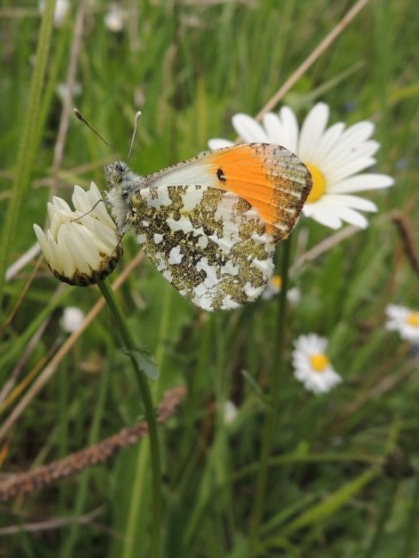
Orange-tip butterfly - Anthocharis cardamines
Topics:
Invertebrates
 |
| Female Orange-tip |
Location: Nr. Silver Street wood, Wiltshire
Resources: http://www.britishbutterflies.co.uk/species-info.asp?vernacular=Orange-tip

Location: Farley Hungerford, Somerset Follow my blog with Bloglovin
Subscribe to:
Posts (Atom)